Business owners will spend serious money on equipment, inventory, attorneys, insurance, payroll, rent, branding, software, marketing, and operations.
Then they try to save a few dollars on the one thing responsible for turning strangers into leads and customers: their website.
That is not a smart savings strategy.
That is stepping over a dollar to pick up a dime.
DIY website builders make it easy to launch something that looks like a website. Wix, Squarespace, GoDaddy Website Builder, Webflow, Shopify templates, and other hosted platforms can all help someone get online quickly. For a hobby, side project, temporary page, or business that only wants to say “we have a website,” that may be enough.
But if your website needs to generate leads, rank in Google, support paid advertising, track conversions, connect to business systems, scale with the company, or represent your business professionally, a DIY website builder is usually the wrong tool.
A real business website is not just a collection of pages.
It is part of your business infrastructure.
At eCreations, we don’t start with templates. We start with the business. We look at ownership, domain control, DNS, hosting, content, search visibility, analytics, lead capture, performance, integrations, scalability, and long-term flexibility. The website is only one piece of the system.
Most website builders are designed to help people publish pages.
A serious business website should be engineered to produce results.
What DIY Website Builders Are Actually Good For
DIY website builders are not useless. They have a place.
They are fine for someone who wants a basic online presence and does not expect the website to do much heavy lifting.
That may include:
- A hobby project
- A personal portfolio
- A temporary landing page
- A very early proof-of-concept
- A business that is not relying on search, leads, or conversions
- Someone who simply wants to say, “I have a website”
That is the honest answer.
If the website does not matter much, a DIY builder may be acceptable.
The problem starts when a business expects a DIY website to behave like a professional business asset.
That is where the shortcut breaks down.
The Problem With DIY Website Builders for Real Businesses
DIY website builders are sold as simple, affordable, and fast.
The hidden tradeoff is control.
Most business owners do not discover that tradeoff until they need to do something the platform does not handle well.
They want a custom layout, but they are stuck inside a template.
They want better SEO, but the platform limits what can be controlled.
They want better speed, but they are sharing a hosted environment they cannot optimize deeply.
They want custom functionality, but the platform only supports certain apps, plugins, extensions, or add-ons.
They want clean analytics and conversion tracking, but the setup is limited, messy, or disconnected from the rest of their marketing.
They want to move the site, but the content, design, data, or structure cannot be exported cleanly.
They want to scale, but the system was never designed around their business in the first place.
That is the difference between “having a website” and owning a web platform that supports the business.
DIY platforms make website creation feel easy. They are not designed to give serious businesses maximum control over ownership, infrastructure, SEO, performance, data, integrations, and long-term flexibility.
You May Not Own As Much As You Think You Own
One of the first things we look at when evaluating a website is ownership.
Not design.
Not colors.
Not fonts.
Ownership.
Who owns the domain?
Where is DNS managed?
Who controls hosting?
Where is the website actually located?
Who has access to analytics?
Is Google Search Console configured?
Where do form submissions go?
What happens if you leave the platform?
Can the content be exported?
Can the design be moved?
Can the data be accessed?
Can the site be rebuilt somewhere else without starting over?
These questions sound technical, but they are business questions.
The frightening reality is that many business owners do not know who owns their domain, where their DNS is managed, what hosting even means, or what systems are connected to the website.
That is not their fault.
They are running a business, not managing web infrastructure.
But it becomes a serious problem when the business depends on a website that nobody fully understands or controls.
At eCreations, we love educating clients on this. We diagram how everything works. We identify what they own, what they control, and what they are renting.
Because before a website can perform, the business needs control of the foundation underneath it.
The Hidden Cost of “Saving Money” on a Website
DIY website builders look cheaper upfront.
That’s the bait.
The real cost usually shows up later.
A business owner may save money on the initial build, but then spends hours fighting the platform, working around limitations, trying to make templates fit, struggling with SEO, guessing at analytics and conversion tracking, and wondering why the site does not produce leads.
That’s not savings.
It’s lost time, lost traffic, lost leads, lost credibility, and often a future rebuild.
The harsh truth is this:
A cheap website that does not generate business is not cheap.
It’s expensive.
It’s expensive because it wastes the money already invested in the business. You paid for the equipment, inventory, attorneys, branding, marketing, payroll, and operations. But if the website does not attract visitors, build trust, generate leads, or convert prospects, the business is leaving money on the table every day.
A website should make the rest of your investment work harder.
If it doesn’t, it is not an asset.
It’s a bottleneck.
Before choosing the cheapest path, it helps to understand how much a business website really costs — not just upfront, but over the life of the business.
A Website Builder Is Not Business Infrastructure
Most DIY website platforms focus on the visible part of the website.
Pages. Images. Templates. Buttons. Basic forms. Simple edits.
That is only the surface.
A serious business website involves much more:
- Domain ownership
- DNS management
- Secure hosting
- CDN configuration
- CMS control
- Mobile performance
- Search engine visibility
- Technical SEO
- Redirects
- Analytics
- Google Search Console
- Conversion tracking
- Lead forms
- CRM integrations
- Email deliverability
- Backups
- Security
- Scalability
- Ongoing support
That’s why the wrong platform creates problems.
The website may look fine on the surface, but underneath, the business is boxed into a system that limits growth.
A real web agency should not just ask, “What do you want the site to look like?”
It should ask:
What does the business need this website to do?
Who needs to manage it?
How will leads be captured?
How will success be measured?
How will the site support SEO?
How will it handle future growth?
What systems does it need to connect to?
What happens if the business expands?
What happens if the platform no longer fits?
That is the difference between design and architecture.
Most agencies sell design.
eCreations engineers the web infrastructure behind the business.
What Happens When Businesses Outgrow DIY and Proprietary Platforms
We see this all the time.
Businesses come to eCreations after starting on platforms that seemed easy at first but became limiting over time.
Anderson’s Coffee came to us from Webflow.
Unique Design Solutions came from a proprietary platform.
Visionedge came from Shopify.
Snipersharp came from Shopify.
The exact details vary, but the pattern is familiar.
The business reaches a point where the platform is no longer helping.
It’s restricting.
Common issues include limited control, template constraints, poor scalability, unreliable hosting, weak SEO performance, slow page speed, platform-owned or platform-controlled data, difficult modifications, and expensive workarounds.
At that stage, the business does not just need a redesign.
It needs a better foundation.
That usually means moving to a platform with more control, more flexibility, better ownership, and a cleaner path for long-term growth.
For many businesses, that platform is WordPress.
Not because WordPress is trendy.
Because WordPress gives a business control.
A strong professional web design process should not simply make the site look better. It should remove the technical and strategic limitations that were holding the business back.
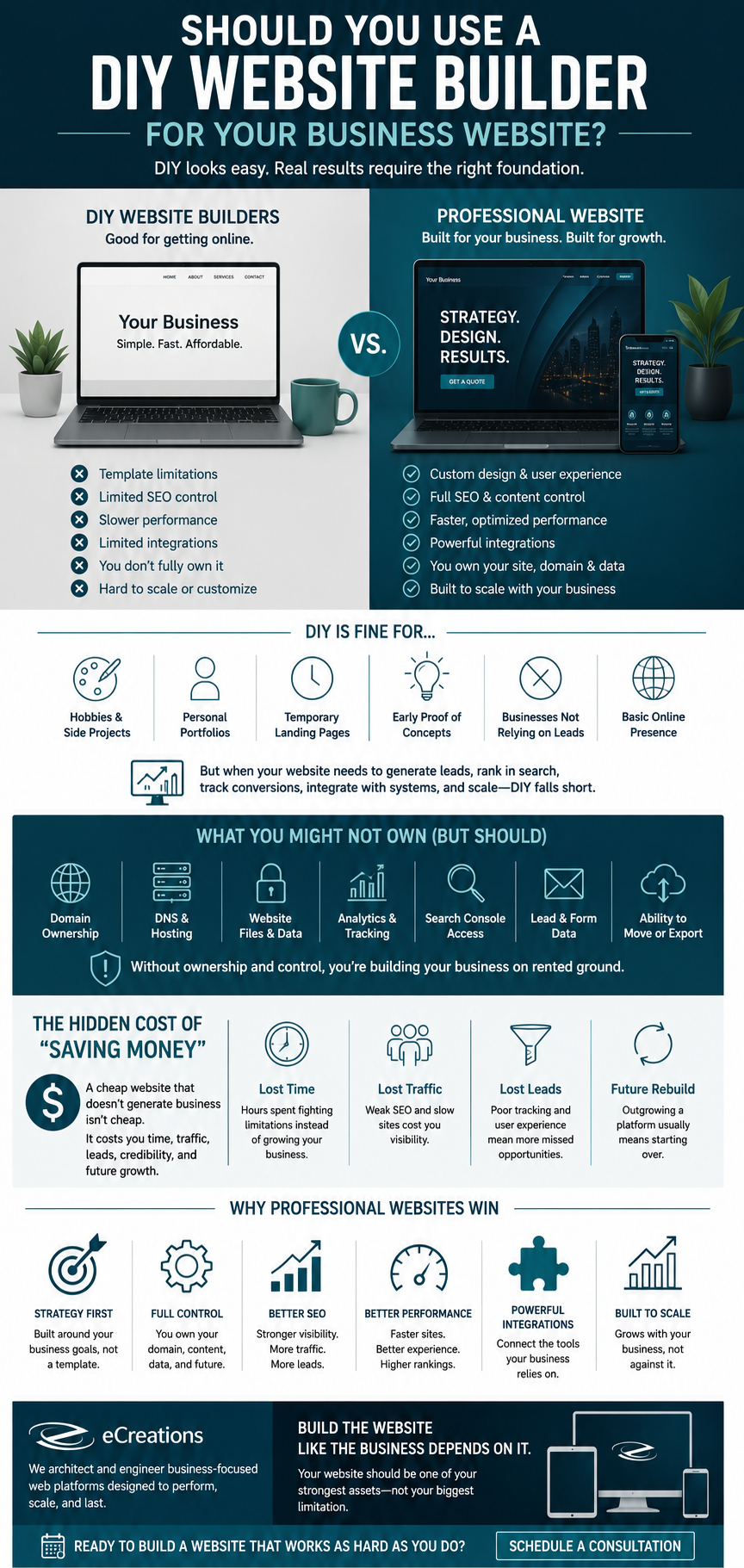
A serious business website is more than a page builder. The infographic below breaks down where DIY website builders usually fall short — and what a professional business website needs to control, measure, and scale.
Why WordPress Is Usually the Better Foundation for Serious Business Websites
WordPress is not automatically better just because it is WordPress.
A poorly built WordPress site can be just as bad as any other bad website.
But when WordPress development is planned, built, optimized, hosted, and maintained correctly, it gives businesses something DIY platforms often do not:
Control.
Control over design.
Control over content.
Control over SEO.
Control over hosting.
Control over performance.
Control over integrations.
Control over data.
Control over future growth.
That matters.
A business should not have to rebuild its entire website just because it outgrew a template. It should not be trapped because the platform makes migration difficult. It should not be limited because the builder cannot support the functionality the business now needs.
A good WordPress website can evolve with the business.
That’s the point.
Why eCreations Starts With the Business, Not the Website
At eCreations, we do not believe the first step is picking a template.
The first step is understanding the business.
What does the company sell?
Who is the buyer?
How does the business generate leads?
What does the sales process look like?
What markets does it serve?
What systems are already in place?
What is broken now?
What needs to scale?
Who owns the domain?
Where is DNS managed?
Where is the site hosted?
What marketing data exists?
What does Google already know about the site?
Where are the conversion opportunities?
What should the site do after launch?
That is the difference between building a website and engineering a web presence.
We look at the entire stack: domain, DNS, hosting, CDN, content, SEO, analytics, forms, integrations, performance, security, and support.
Then we build the website around the business.
Not the other way around.
That’s why our approach to business-focused web design goes beyond layout, color, and pages. The goal is to create a foundation the business can actually use, measure, improve, and grow from.
When Should You Hire a Professional Web Designer?
You should hire a professional web designer or web agency when the website needs to support the business in a meaningful way.
That includes businesses that need:
- Better visibility in search engines
- More qualified leads
- Stronger credibility
- Better conversion rates
- Custom layouts
- Custom functionality
- Local SEO
- eCommerce flexibility
- Analytics and conversion tracking
- CRM or third-party integrations
- Paid advertising support
- Better performance
- Better content structure
- Long-term scalability
- Ownership and control
- Ongoing technical support
If the website is part of how the business grows, it deserves professional planning.
That does not mean every business needs a massive custom build.
It does mean the website should be built with purpose.
A serious business website should be planned around search, speed, usability, conversion, tracking, ownership, and growth from the beginning.
Before choosing an agency, it also helps to know the right questions to ask before hiring a web designer.
So, Should You Use a DIY Website Builder?
Here’s the straight answer:
If your website doesn’t need to generate leads, rank in search, support marketing, track conversions, connect to systems, scale with the business, or represent your company at a high level, a DIY website builder may be enough.
But if your website needs to produce business results, a DIY builder is usually the wrong place to save money.
You didn’t invest in equipment, inventory, attorneys, insurance, operations, branding, and marketing just to put your growth behind a rented template with limited control.
Your website should not be the weakest part of your business.
It should be one of the strongest.
Build the Website Like the Business Depends on It
Because it probably does.
A professional website is not just about looking better. It is about building a foundation that supports visibility, credibility, conversions, ownership, tracking, and future growth.
If your current website is on Wix, Squarespace, GoDaddy Website Builder, Webflow, Shopify, or another proprietary platform, and you are starting to feel boxed in, that is usually not a coincidence.
It may be time to look at the bigger picture.
At eCreations, we help businesses understand what they own, what they control, what is holding them back, and what needs to happen next.
We do not just build websites.
We architect and engineer business-focused web platforms designed to perform, scale, and last.